
Project AI Trader
- Project: Adaptive Trading Automation
- Company: Sepehr Noavar Avizhe Hoshmand (SNAH)
- Client: Proprietary / R&D
- Date: 08 October, 2025
- Duration: 6 months (Phase I)


Project overview
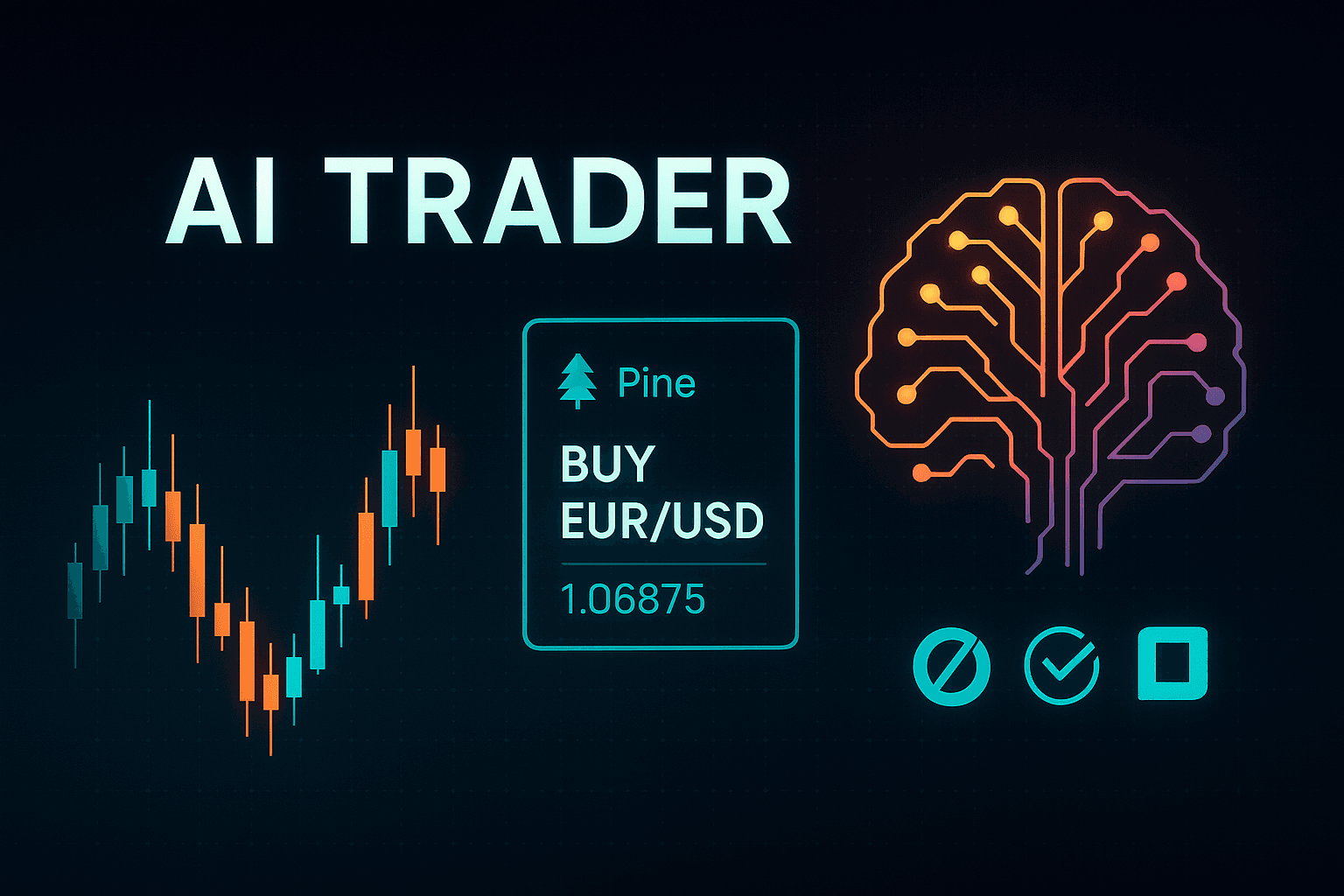
AI Trader is an end-to-end, API-driven trading platform that consumes Pine strategy alerts and live market data, then routes validated orders to multiple brokers. The system supports backtesting, paper trading, and live execution, giving traders a single control plane for strategy iteration and deployment.
The model is trainer-friendly: traders can label outcomes, attach notes to signals, and provide human feedback that improves the policy over time. A feature store, episodic evaluations, and checkpointed models ensure reproducibility and safe rollbacks.
Connectivity is designed for resilience: REST/WebSocket adapters for major crypto/forex/equities brokers, retry-aware order routing, rate-limit handling, and comprehensive audit logs. Guardrails (position sizing, max drawdown, kill switch) keep risk under control while enabling rapid iteration.
Client challenges & requirements
Production trading demands latency-aware execution, robust risk management, and models that resist overfitting while adapting to regime changes.
- Low-latency signal ingestion and order routing under broker rate limits and network jitter.
- Strategy drift and overfitting in non-stationary markets; need for ongoing evaluation and rollbacks.
- Unified risk controls across heterogeneous brokers and instruments.
Project solution
We implemented an event-driven architecture: Pine webhooks and market streams feed a validation layer, feature store, and a policy engine. A scheduler handles backtests/paper/live runs with the same code path. Risk guardrails (exposure caps, per-trade limits, circuit breakers) are enforced pre-trade and post-trade. Connectors abstract broker specifics, while an audit log captures signals, decisions, and outcomes for compliance and learning.
5+
Broker connectors
3 modes
Backtest / Paper / Live
24/7
Monitoring & alerts
100%
Reproducible runs
Your complete FAQ guide to AI Trader
Answers to common questions about Pine-driven, API-connected trading with human-in-the-loop training.
No. AI Trader is tooling for research, automation, and execution with risk guardrails. It does not provide financial advice; traders remain fully responsible for decisions.
Label trades, provide feedback on entries/exits, and attach notes to Pine alerts. The system aggregates feedback to update the policy, with evaluation and rollback controls.
Yes. Pine alerts are received via secure webhooks, normalized, validated, and fed into the execution pipeline.
The connector layer supports multiple crypto/forex/equities brokers via REST/WebSocket APIs. Specific connectors are enabled per deployment.
Pre-trade checks (position sizing, max loss), runtime kill switches, daily exposure caps, and post-trade analytics enforce disciplined risk.