
Project Genovision
- Project: AI Prenatal Screening
- Company: Sepehr Noavar Avizhe Hoshmand (SNAH)
- Client: Healthcare R&D Partners
- Date: 08 October, 2025
- Duration: 6 months (Phase I)


Project overview
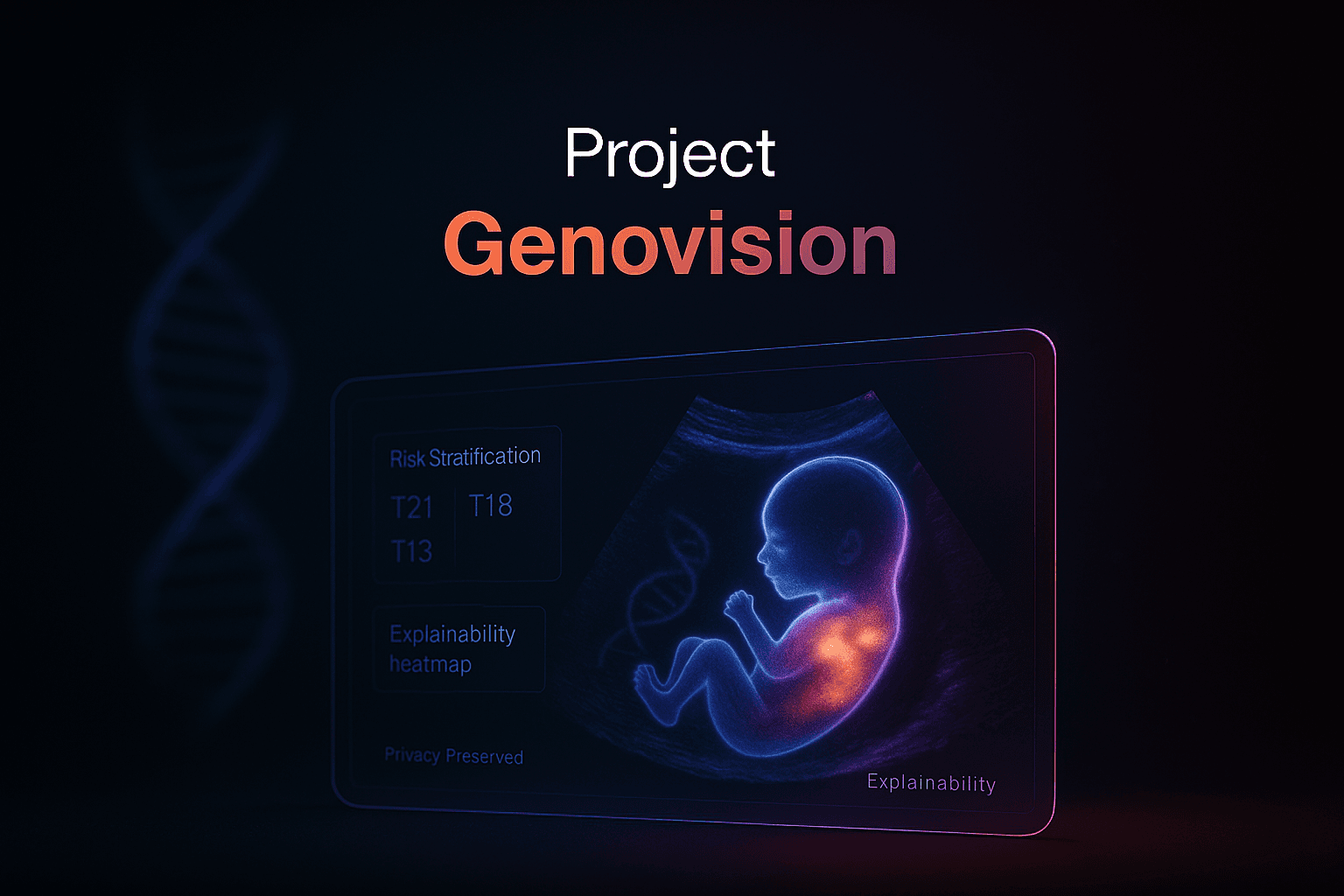
Genovision is an AI-assisted prenatal screening project focused on early risk stratification for common fetal chromosomal anomalies such as trisomy 21, 18, and 13. The system ingests multimodal inputs—ultrasound frames/biometrics and structured laboratory data—and outputs an interpretable risk score to support clinical decision-making.
The pipeline emphasizes privacy and clinical safety: de-identification at source, reproducible preprocessing, careful dataset governance, and model cards documenting intended use and limitations. Explainability (e.g., saliency/Grad-CAM) highlights image regions that most influenced the prediction, helping clinicians audit model behavior.
Genovision is designed as a modular platform with an inference API, optional on-premise deployment for hospitals, and a secure audit trail. While not a diagnostic device, it aims to reduce cognitive load, standardize screening quality, and surface high-risk cases for timely follow-up.
Client challenges & requirements
Clinical AI must balance sensitivity with specificity, remain robust across devices and populations, and provide transparent reasoning that augments, not replaces, expert judgment.
- Data heterogeneity across ultrasound devices and acquisition protocols; class imbalance for rare anomalies.
- Bias mitigation and domain generalization to avoid overfitting to a single site or demographic.
- Regulatory and privacy constraints (consent, de-identification, auditability) with reliable MLOps in clinical settings.
Project solution
We built a reproducible, privacy-preserving training and inference stack: curated de-identified datasets, augmentation tailored to sonography artifacts, self-supervised pretraining on large unlabeled frame sets, and an ensemble of calibrated classifiers. Explainability overlays (e.g., Grad-CAM) and confidence calibration accompany every prediction. An MLOps layer (versioned data, drift monitoring, and human-in-the-loop review) supports continuous improvement. Deployments are available via secure API or on-premise edge servers.
0.94 AUC
Pilot internal validation*
3+
Supported anomaly categories
2 modes
Cloud & on-prem
100%
De-identified training data
Your complete FAQ guide to Genovision
Answers to common questions about AI-assisted prenatal screening and how Genovision supports clinical workflows.
No. Genovision is a decision-support tool and should not be used as a standalone diagnostic. Clinical decisions remain with qualified healthcare professionals.
Initial focus is on common chromosomal anomalies (e.g., trisomy 21/18/13). The roadmap includes broader anomaly coverage subject to data quality and clinical validation.
The model provides saliency-based overlays (e.g., Grad-CAM) that highlight regions most influential to the prediction, together with a calibrated confidence score to assist review.
We use stratified sampling, domain-specific augmentation, cross-site validation, and ongoing monitoring for drift. Model cards document datasets, limitations, and intended use.
Yes. Hospitals can deploy an on-premise inference node with secure APIs, or use our cloud endpoint with end-to-end encryption and strict access controls.